





5 steps to your dream staircase
If you don’t plan exactly in advance for conversion and renovation work, you will quickly be faced with unpleasant surprises. This also applies to the installation of stairs. To avoid such situations, we have summarized the planning process of a staircase for you here. With this guide, you can plan your staircase in five easy steps.
Step 1: Clarify the framework conditions
Before you start planning your staircase in detail, you should think about the general conditions. To do this, you should consider what spatial conditions exist and what your needs are. Ask yourself the following questions:
- Where should my stairs be located? It makes a big difference whether you want to use your stairs indoors or outdoors. The available space is also decisive for the choice of stairs. For example, you may have to literally think outside the box due to the structural requirements and consider a quarter-turn staircase.
- What do I want to use my staircase for? Before buying a staircase, you should be clear about how and what you want to use your staircase for. If you only need to have access to the next floor occasionally, a foldable staircase is an option, for example. If, on the other hand, you walk up and down regularly, a fixed system staircase may be a better choice.
In this context, it is important to note that all our products are considered non-necessary stairs. According to the building regulations of DIN 18065, such a staircase may only be used as an “additional staircase that may also serve the main use”.
Step 2: Select the type of staircase
Based on your considerations about the general conditions, you can then decide which type of staircase is suitable for you in the first place. If you are flexible in this regard or have special spatial requirements, you can also bring forward step 3 if necessary and only determine the type of staircase after the measurement.
We have summarized which stairs there are and what special features distinguish them for you here:
ATTIC STAIRS
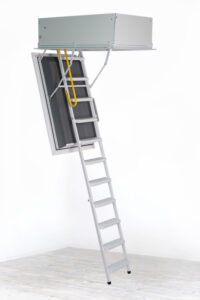
Attic stairs are stairs that are designed for occasional use only and can be folded in and out for this purpose. Basically, there are three different types of loft stairs: foldable wooden or steel stairs, which consist of three to four ladder sections, and retractable scissor stairs, which can be pulled apart like an accordion, so to speak.
For the materials for the ladders, Minka relies on solid wood and powder-coated steel. The feeder in which the staircase rests when folded can also be made of solid wood or MDF panels.
Before you buy an attic staircase, it is essential to decide whether you need a fire-retardant effect and how much the staircase should insulate the room. Fire protection is specified in classes EI230, EI245 and EI260, depending on whether the attic staircase slows down the spread of fire by 30, 45 or 60 minutes. When it comes to thermal insulation performance, the U-value is the essential key figure. The lower this is, the better the insulation effect.
SPIRAL STAIRCASES
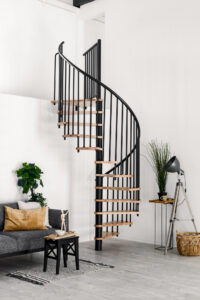
Spiral staircases are a special form of spiral staircases. Spiral staircases have a railing on both sides and rotate around an open center point. Spiral staircases, on the other hand, have so-called spiral tubes in the centre, between which the steps are attached, and only have a railing on the outside. As a result, spiral staircases are significantly more space-saving compared to spiral staircases. Thanks to our flexible kit, all Minka spiral staircases can be mounted both left and right spiral.
Our spiral staircase models differ in the following features:
- Material: Our range includes spiral staircases with wooden or metal steps. The stair railings are made of powder-coated steel. For outdoor use, we also have spiral staircases with galvanised metal parts in our range.
- Types of railings: Our spiral staircases are divided into different models depending on the type of railing. For example, some items have a railing with stainless steel lower chords, while others have a railing with vertical bars. Our stairs with step railings are also particularly striking. The handrail is usually made of wood or PVC.
- Types of wood: For spiral staircases with wooden steps, we currently offer models with beech or oak wood. Special highlights are the beech steps, which are stained to a dark walnut look or painted white.
- Metal colors: The steel parts can be powder-coated in black, white, or gray. Individual models are also available in the colour anthracite.
- Diameter: The diameter of our spiral staircases can be 100, 120, 140 or 160 cm.
SPACE-SAVING STAIRS
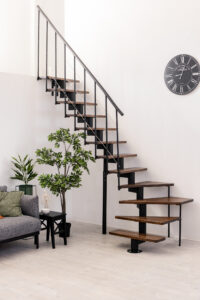
Most of Minka’s space-saving staircases are so-called central spar stairs. In this variant, the steps are held by load-bearing elements along the centerline, which allows flexible installation with different pitch angles.
As the name suggests, space-saving stairs are characterized by the fact that they require very little space. For particularly winding room situations, many Minka models have the option of setting them up slightly turned to the left or right. In addition, some models are also available as quarter-spiral or even half-spiral variants.
We currently have space-saving stairs with steps in beech or walnut look in our range. There is the same choice of metal colours and railing types as for spiral staircases.
EXTERNAL STAIRS
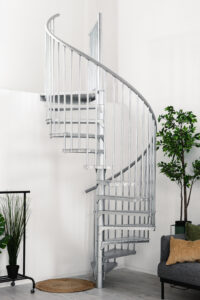
If you need a staircase for outdoor use, you should make sure that the material is suitable for outdoor use. Minka relies on galvanized steel for outdoor stairs, as it is extremely resistant to environmental influences. Minka’s range includes both spiral staircases and straight models for outdoor use.
When planning outdoor stairs, it is important that there is a stable foundation and a safe exit option at the upper end. If you are not a professional in this regard, it is advisable to consult construction experts.
CUSTOM-MADE STAIRS
In the event of adverse structural specifications, only a custom-made staircase may be an option. As a manufacturer of stairs with a modular system, Minka has only a limited selection of standard sizes for almost all stairs. Minka only offers custom-made solutions for some attic stairs – e.g. the Type 118M, Type 102M and Type 4M. Please note that the delivery time for these models is longer than for standard sizes and that there is no right of return.
Step 3: Measure the room
To know which stairs are suitable for your room, you need to measure the available space exactly. The following parameters are particularly important when planning your stairs:
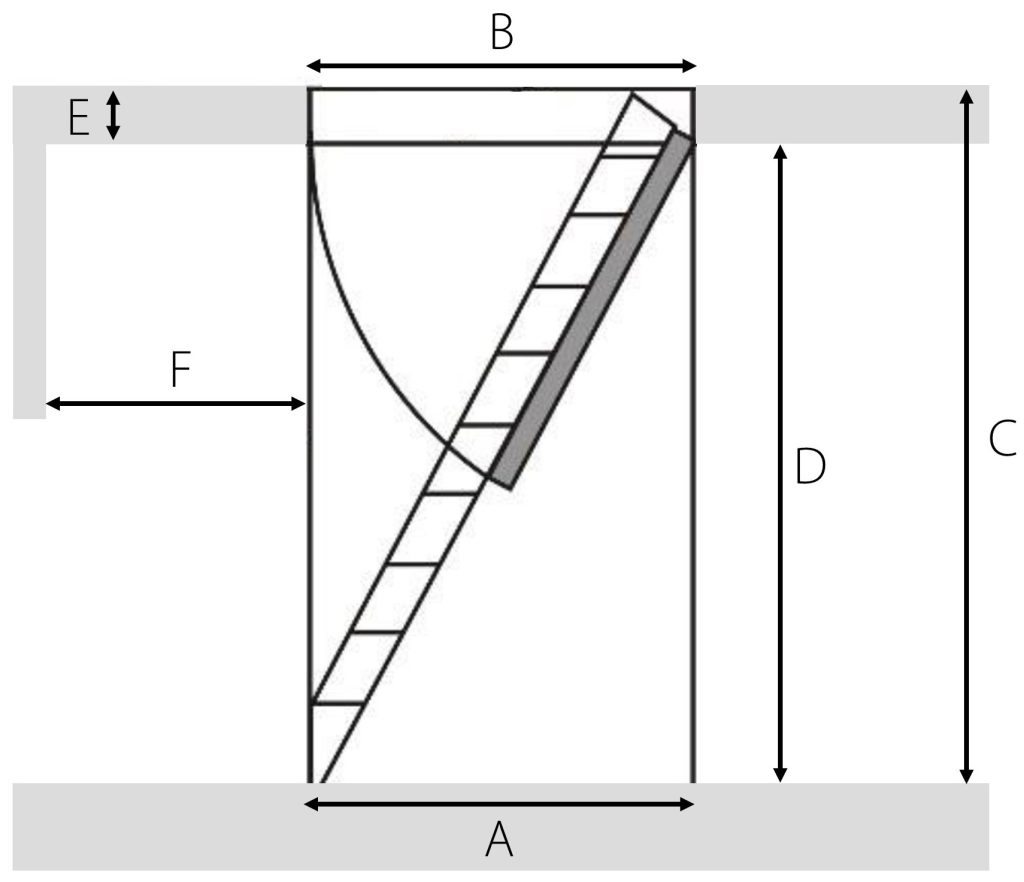
- Basic dimensions (A): The basic dimension is the length and width that a staircase occupies when viewed from a bird’s eye view. To determine this, you can either use a floor plan of the room or measure the available space on the floor of the room. Don’t forget that they also need space to enter the first step. It is therefore best not to put it against a wall, but to be freely accessible. In the case of attic stairs, the basic dimensions are also referred to as a so-called projection.
- Dimensions of the ceiling opening (B): In addition to the space available on the floor, it is also important to know the shape and dimensions of the ceiling opening:
- Rectangular or square ceiling openings: With a rectangular ceiling opening, you have the widest choice of staircase models. Depending on the size, attic stairs as well as spiral staircases and space-saving stairs fit in here. For our loft stairs, the available shell sizes are indicated on the product page in the webshop, in the price list and in the technical data sheet. For spiral staircases, the ceiling opening should be about 10 cm larger than the diameter of the staircase. In the case of space-saving stairs, on the other hand, it is important that the ceiling opening is long enough so that you do not bump your head when going up and down.
- Round ceiling openings: In the case of round ceiling openings, the diameter is the relevant parameter instead of the side lengths. If your ceiling hatch is round, usually only a spiral staircase is an option. Minka offers stairs with a diameter of 100, 120, 140 and 160 cm, but the ceiling opening should also be around 10 cm wider. Under certain circumstances, a special exit platform may also be necessary for round ceiling openings.
- L-shaped ceiling openings: Space-saving stairs with a quarter turn are particularly suitable for L-shaped ceiling openings. These L-shaped stairs fit perfectly into winding rooms.
- Gallery: If you want to climb a gallery with your stairs, only space-saving stairs and spiral staircases come into question. Here, especially in the case of spiral staircases, the angle of rotation must be planned so that the staircase does not end against a wall, but can be accessed from both below and above.
- Room height: Another important key figure for planning your staircase is the room height. For an exact measurement of the room height, it is essential that you measure at right angles to the floor. It can be helpful to place the tape measure or folding rule along a wall. When it comes to room height, experts distinguish between two dimensions:
- Floor height (C): The floor height is the distance from the upper edge of the finished floor to the upper edge of the ceiling or gallery. This parameter is important for the planning of system stairs.
- Clear room height (D): The clear room height, on the other hand, is measured from the upper edge of the floor to the lower edge of the ceiling. It is decisive for the choice of attic stairs.
- Ceiling thickness (E): In addition to the clear room height, the ceiling thickness is also a relevant figure for attic stairs. It is best to measure these from the bottom edge to the top edge of the ceiling when you open your ceiling.
- Fold-out space (F): Attic stairs usually require a certain amount of space to fold out. This area goes beyond the basic dimensions of the stairs. So please make sure that there is enough space for the ladder to be unfolded. You can find the necessary fold-out space for all Minka attic stairs in our technical data sheets.
Step 4: Select model
Once the measurements are clear, you can start the actual staircase research. In the online shop you will find all the information about our stairs. Feel free to use the various filter functions to narrow down the selection to suitable models more quickly. On the product pages, you will then find pictures, texts and technical details of the respective staircase – the technical data sheets, installation instructions and various certificates are also linked here for you.
For everyone in Austria, our showroom in St. Lorenzen im Mürztal is also worth a visit. There you can see and walk through our stairs live after making an appointment by phone. Our specialist staff will be happy to help and advise you. But our numerous trading partners are also good points of contact for further information. In many DIY stores you can get personal advice on the selection. Alternatively, you can also browse through various other online shops where Minka is represented.
Step 5: Order stairs
Once you have decided on a model, nothing stands in the way of ordering. You can buy our products directly from our online shop – but please note that we only offer our stairs at a list price. For this reason, we recommend purchasing our products from one of our numerous retail partners, as they are usually much cheaper there.
Minka stairs are available in all large DIY stores, but also at many small retailers. To place an order, you only need the name of the stairs, the size and the metal and/or wood colour. The article number can also be extremely helpful when ordering through dealers – you can find this in our price list or by configuring the products in our online shop.
We hope that this guide has been helpful to you and that it will make it easier for you to plan your stairs! If you have any questions, you are also welcome to contact our specialist staff personally. Please use the contact details given under Contact .